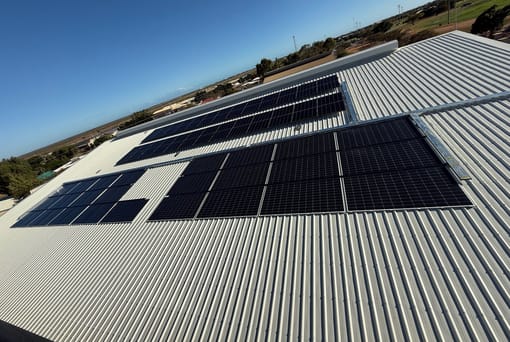
In a series of firsts, we recently completed the installation and testing of lightweight solar panels on our Carnarvon Depot.
The Carnarvon Depot Lightweight Solar Panel Project supports the uptake of behind-the-meter (BTM) commercial solar and facilitates the investigation of emerging energy technologies.
The project was engineered to create a controlled test between:
- Traditional glass modules (500 W), using established technology with known durability and efficiency; and
- 520 W lightweight modules, incorporating frameless, glass-free construction offering significant weight reduction, easy handling and potential applications where roof loading is restricted.
Andrea Thomas, Customer Programs Manager, said it’s exciting to see Horizon Power explore the potential of this new technology.
“These lightweight panels open new opportunities for renewable deployment and valuable insights into whether the advantages come with trade-offs. So far, initial feedback is that the panels are extremely lightweight, flexible and durable.”
Installation and testing
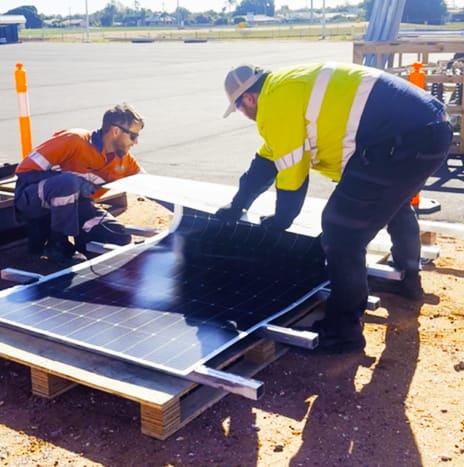
Installations occurred over two tranches, with the traditional panels installed in June. In another first, our installers successfully deployed a glue-down method to secure the lightweight panels to the roof during the second tranche.
The lightweight panels held up well throughout rigorous vandalism testing, which included impact resistance testing (e.g., dropping a 1kg steel ball) and a projectile throw simulation (e.g., throwing rocks or debris at the panels). Only the scratch resistance testing appeared to leave a visible mark on the panel, but did not compromise output.
Early results from initial testing indicate the output of the lightweight panels remained consistent from beginning to end at 47 volts. While the lightweight panels proved more difficult to remove from the glue-down installation than expected, electrical testing following the removal exercise showed the panel still produced 46 volts, despite being under considerable stress during its removal.
Both systems are now live with the project team set to log and analyse key data sets in the coming months, including energy yield, inverter efficiency, temperature performance, degradation rates and any differences in installation/maintenance requirements.
Reflecting on how this program supports our Corporate Strategy and our Customer Energy Resources (CER) uptake goal to deliver 300MW of coordinated CER by 2030, Andrea said, “this project helps us demonstrate leadership in renewable energy uptake as well as trial new technology that may remove barriers our customers face, like roof strength, cyclone-zone regulations, vandalism, and high freight costs”.